
Anxiety rarely shows up all at once. Most of the time it creeps in slowly, through small changes that are easy to brush off as a busy week, a bad night’s sleep, or just stress.
But when those small changes start to stack up and stick around, they’re often the early signs of something that deserves real attention.
At Serene Behavioral Healthcare, we talk to people every week who tell us the same thing: “I didn’t realize how long this had been building.”
Catching it early makes treatment easier and recovery faster, so here’s what we want you to watch for, in yourself or in someone you care about.
Anxiety Signs That Are Easy To Miss
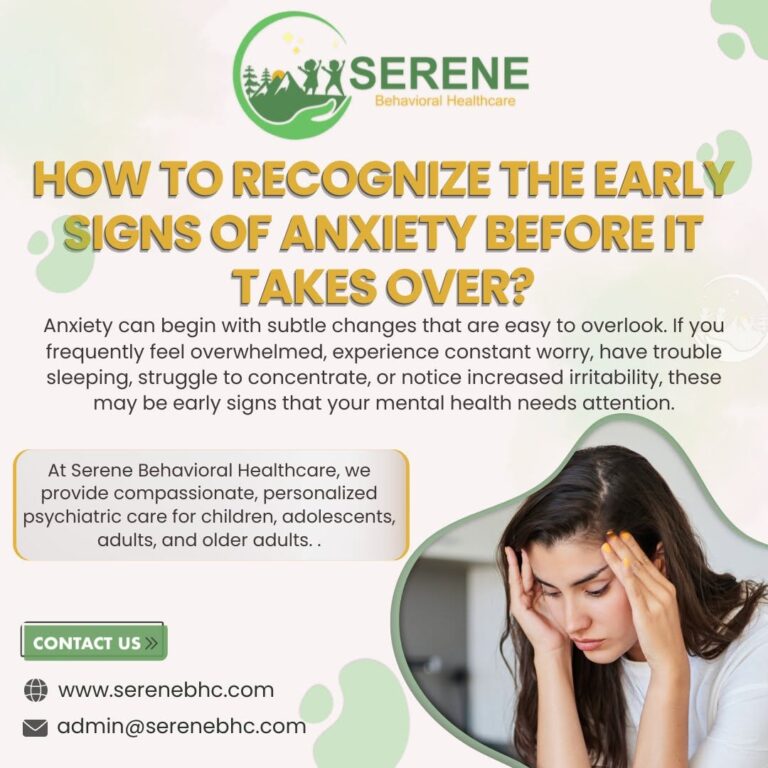
Anxiety doesn’t always look like panic. More often, it shows up as:
- A worry that won’t turn off. Not the occasional nervous thought before a big meeting, but a running background hum of “what if” that follows you through the day
. - Feeling overwhelmed by things that used to feel manageable. A full inbox, a normal errand list, a regular conversation, all of it suddenly feels like too much.
- Trouble sleeping. Lying awake replaying the day, waking up in the middle of the night with your mind racing, or just never feeling rested no matter how many hours you got.|
- Difficulty concentrating. Losing your train of thought mid-sentence, rereading the same paragraph three times, forgetting things you’d normally remember without effort.
- Increased irritability. Snapping at people you love over small things, feeling on edge more often than not, or noticing your patience has quietly worn thin.
Any one of these on its own might just be a rough patch. But when several of them show up together and stay for weeks rather than days, that’s usually your body and mind telling you something needs attention.
Why Catching Anxiety Early Matters
Anxiety that goes unaddressed tends to grow roots. It starts affecting sleep, then work, then relationships, then how you see yourself.
The earlier it’s recognized, the more options you have and the less it takes to feel like yourself again.
Seeking support at this stage isn’t an overreaction. It’s simply choosing to understand what’s happening in your own mind before it has a chance to take over more of your life.
There’s nothing to prove and nothing to wait for. If something feels off, that feeling is worth listening to.
What Anxiety Treatment Actually Looks Like
We provide compassionate, personalized anxiety care for children, adolescents, adults, and older adults. That care always starts with a comprehensive evaluation, because anxiety looks different in every person and every age group, and a plan that isn’t built around you specifically usually falls short.
From there, we build an individualized treatment plan aimed at lasting emotional wellness, not just symptom relief in the short term.
That might include therapy, medication management, or a combination, depending on what’s actually going on and what will genuinely help you.
From Dr. Pereira
As a child and adolescent psychiatrist, I’ve spent my career watching anxiety show up long before anyone calls it anxiety.
A parent tells me their normally easygoing kid has started snapping at siblings over nothing.
An adult patient mentions, almost as an aside, that they haven’t slept well in weeks and just assumed that was normal now.
These are the moments I pay closest attention to, because they’re usually the earliest, clearest signals we get.
In my practice, the pattern I see most often isn’t dramatic. It’s gradual. Someone adjusts their routines quietly to avoid what feels hard, without ever naming what’s actually happening underneath.
By the time people come to see me, they’ve often been managing this on their own for months, sometimes longer, before deciding it was worth bringing to a professional.
My advice is always the same: trust the pattern, not the intensity. You don’t need to be in crisis to deserve support.
If several of these signs have been present for a few weeks running, that’s reason enough to have a conversation with someone who can help you make sense of it.
That’s exactly the work we do here at Serene Behavioral Healthcare, for kids, teens, and adults alike.
– Dr. Lionel Pereira, MD Child & Adolescent Psychiatrist, Serene Behavioral Healthcare
If Any Of This Sounds Familiar
You don’t need to have it all figured out before reaching out. Most people who contact us are simply noticing that something feels different and want to understand why. That’s exactly the right moment to talk to someone.